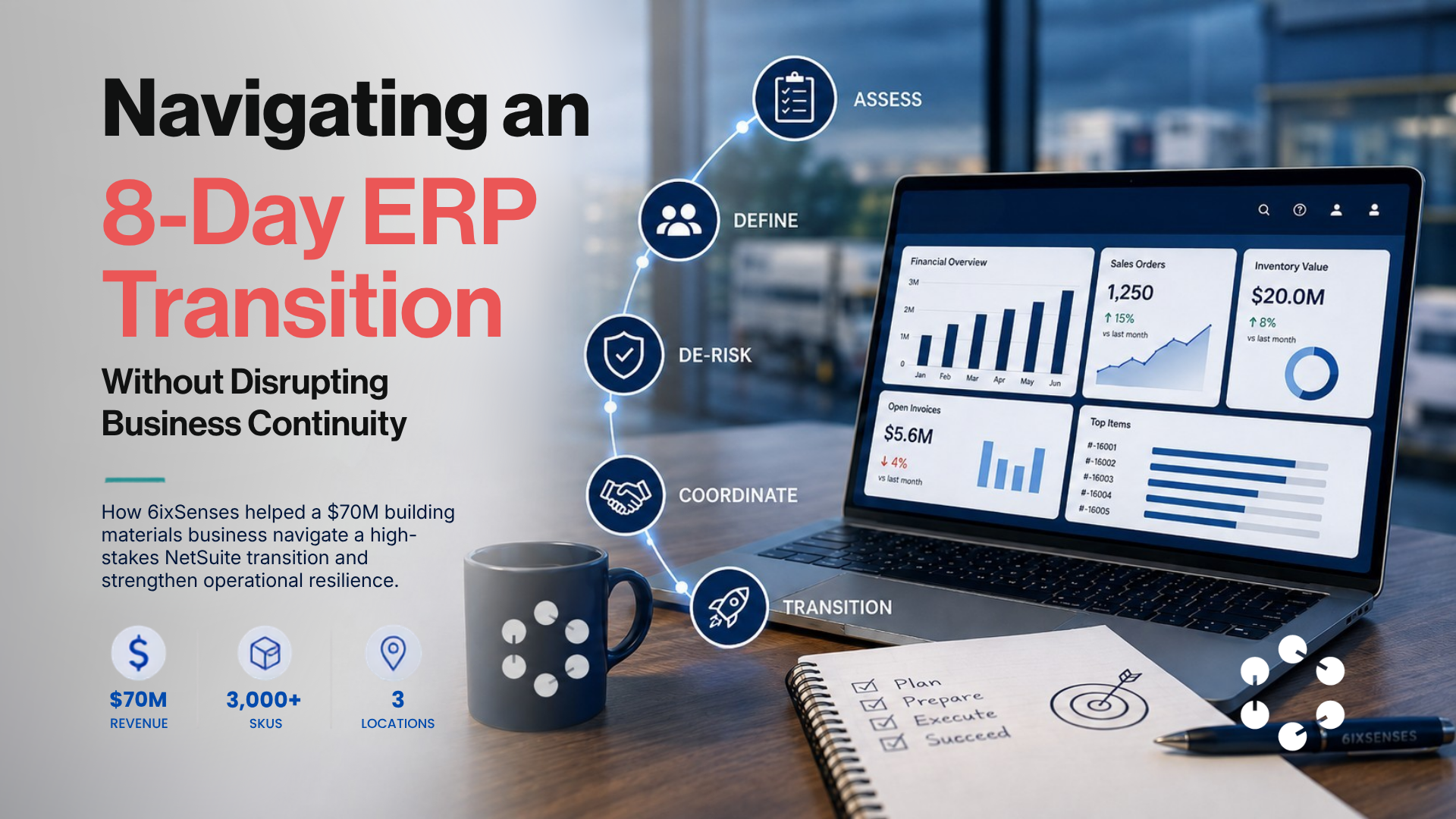
How 6ixSenses helped a $70M building materials business navigate a high-stakes NetSuite transition, manage technology risk and strengthen operational resilience.
When a fast-growing building materials business entered a major asset transition, its technology environment suddenly became business-critical in a new way.
With $70M in revenue, 3,000+ SKUs, approximately $20M in inventory and three operating locations, the business relied heavily on Oracle NetSuite across finance, procurement, inventory, sales and reporting.
But the challenge wasn’t simply moving an ERP system.
The business had eight days to prepare for a critical NetSuite cutover, while recent staff departures had reduced the internal knowledge available to manage the environment.
6ixSenses stepped in as the strategic technology and transformation partner, coordinating stakeholders, managing risk, shaping vendor accountability and establishing the governance needed around the technical transition. Oracle Professional Services handled the technical NetSuite execution.
The Transformation at a Glance
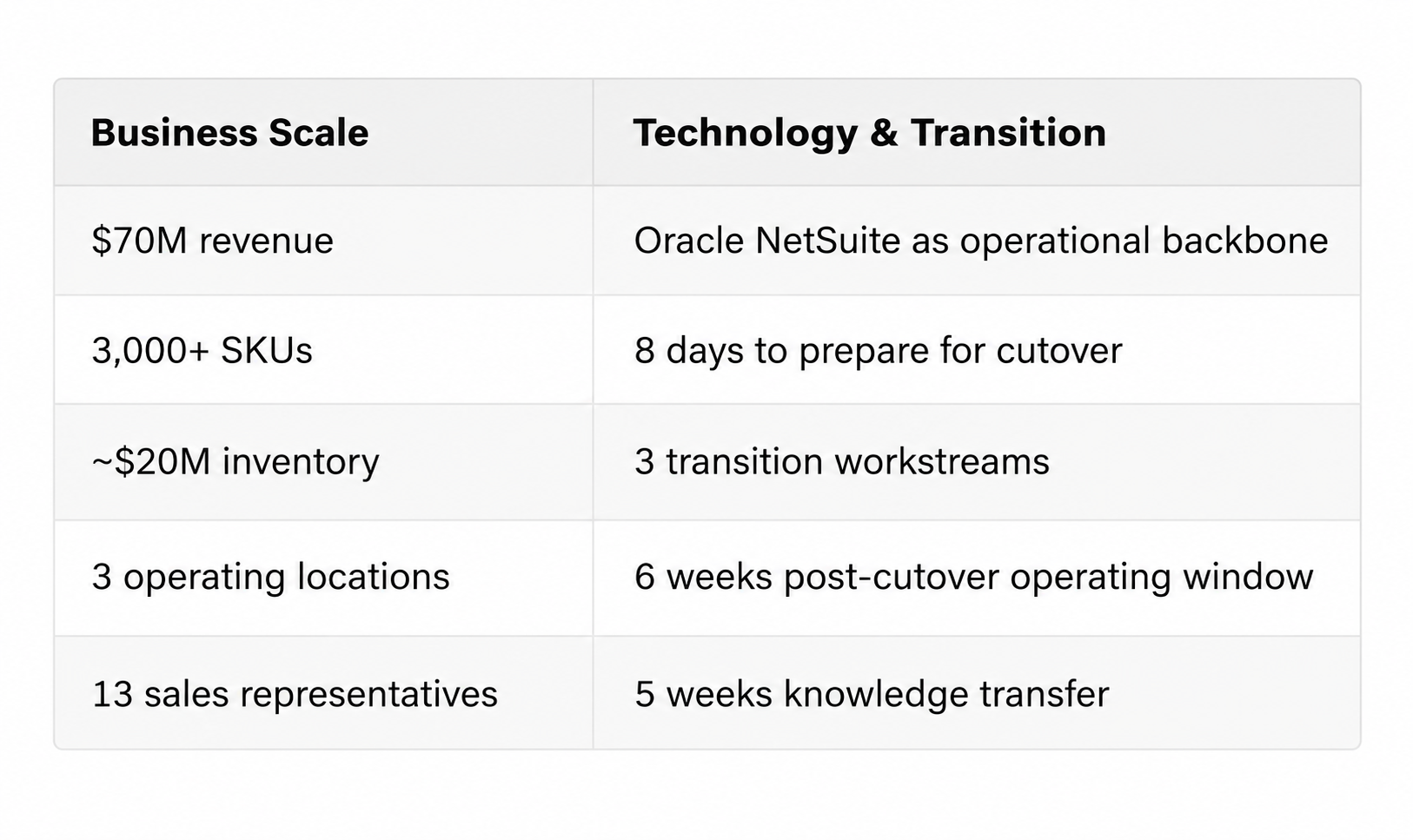
The scale of the operation meant the transition couldn't be treated as a simple ERP migration. Financial records, inventory, users, integrations, reporting and operational processes all had to remain aligned.
WHERE THEY STARTED
A strong technology foundation with a fragile operating model
The business wasn't starting from a position of poor technology.
Its assessment found strong technology capability and high business-system utilization. NetSuite had become the operational backbone supporting sales orders, procurement, accounts payable and receivable, inventory, reporting, branch operations, workflows and integrations.
The challenge was the operating model around the technology.
The assessment identified several clear strengths:
- Technology capability: Strong
- Business-system utilization: High
- Strategic digital foundation: Strong
But several resilience gaps remained:
- Operational dependence on individuals: High
- Documentation maturity: Low–Moderate
- Governance maturity: Moderate–Low
- Operational scalability: Moderate
- Business continuity risk: Medium–High
Critical knowledge was concentrated among individuals. Custom scripts, spreadsheets, manual reconciliation and informal troubleshooting helped keep operations moving.
The technology was capable. The operating model wasn’t yet resilient enough to match it.
THE CHALLENGE
When critical business knowledge becomes a business risk
Several business-critical processes depended on people knowing how things worked, rather than on documented, repeatable processes.
The NetSuite environment contained customizations, scripts, workflows, integrations and reporting dependencies that required specialist knowledge. Recent departures had further reduced internal NetSuite expertise.
Then the stakes increased.
The business was undertaking an asset sale, with NetSuite serving as the system of record.
The transition plan called for a new subsidiary within the existing NetSuite tenant. The historical environment remained preserved for audit, tax and reporting.
And there were only:
8 DAYS
to prepare.
The transition had to account for financial continuity, AR, AP, inventory, fixed assets, user access, integrations, reporting, audit requirements and open transactions crossing the cutover date.
THE 6IXSENSES SOLUTION
Strategic oversight where technical execution needed to move fast
The distinction is important: 6ixSenses did not implement NetSuite.
The eight-day timeline meant Oracle Professional Services handled the technical execution.
6ixSenses focused on the layer around that execution: governance, decision-making, vendor management, risk identification, stakeholder coordination and the post-cutover operating model.
Assess → Define → Govern → De-risk → Coordinate → Transition
Assess the environment
Rather than treating NetSuite as an isolated system, the technology assessment considered the wider environment and its operational dependencies.
More than 10 technology platforms were assessed across areas including ERP, finance, identity, communications, fleet operations and security.
This helped identify where technology capability was strong. And where documentation, governance and operational ownership needed to mature.
Define the cutover
The transition was organized into three workstreams:
01 — Bronze Copy
Create a frozen, evidence-grade snapshot at the transaction cut-off
02 — Operational Cutover
Establish the new subsidiary as the live operating environment
03 — Legacy Wind-Down
Preserve historical information for audit, tax and reporting
The bronze-copy strategy has a sandbox refresh with CSV exports, creating both a queryable environment and portable evidence.
Govern the transition
6ixSenses established the cadence needed to keep a compressed, multi-party transition moving.
The operating rhythm included:
- 15-minute internal check-ins
- Working sessions with Oracle
- Weekly steering meetings
- Cutover-week decision support
- Daily hypercare standups
6ixSenses also owned the process, cadence, escalation paths, vendor management and structural SOW requirements, while technical execution and financial accuracy remained with the appropriate parties.
DE-RISKING THE TRANSITION
6ixSenses focused on nine critical risk areas:
- Audit & legal
Protecting historical records and bronze-copy integrity
- Tax
Addressing implications associated with the new subsidiary
- Financial continuity
Protecting AR, AP, inventory and opening balances
- Open transactions
Managing POs, SOs and bills crossing the cutover
- Integrations
Protecting bank feeds, EDI, payroll, BI and other connections
- Reporting
Maintaining saved searches, dashboards and subsidiary-dependent KPIs
- User access
Ensuring appropriate roles and permissions after transition
- Knowledge continuity
Reducing operational risk following staff departures
- Vendor dependency
Avoiding permanent reliance on Oracle Professional Services
These risks also informed the Oracle SOW, with 6ixSenses pushing for fixed-fee or capped terms, a named lead consultant, defined acceptance criteria, knowledge-transfer deliverables and a defined hypercare window.
THE CUTOVER
Eight days. Three workstreams. One critical transition.
With only 8 days to prepare, the transition required rapid coordination across business, technology and external delivery teams.
6ixSenses provided the governance and strategic oversight needed to keep the program moving, coordinating stakeholders, managing risks, shaping vendor accountability and supporting critical cutover decisions.
The transition was structured around 3 priorities:
01 — Preserve
Protect historical data, records and evidence required for audit, tax and reporting.
02 — Transition
Establish the new subsidiary and ensure the business could continue operating across finance, inventory, users, integrations and reporting.
03 — Stabilize
Move beyond go-live into hypercare, knowledge transfer and the transition towards long-term support.
Oracle Professional Services handled the technical NetSuite execution, while 6ixSenses remained focused on governance, coordination, and risk management throughout the transition.
BUILDING CAPABILITY WITHOUT DEPENDENCY
Turning operational knowledge into repeatable capability
The transition also highlighted a second challenge: what happens when the people who understand a complex system are no longer available?
A five-week NetSuite knowledge-transfer program was established to build internal operational capability.
The program moved progressively through:
Week 1 – Orientation & shadowing
Week 2 – Daily operations
Week 3 – Reporting & inventory
Week 4 – Reporting mastery & variance work
Week 5 – Independence & edge cases
The program included 15-minute daily standups during Weeks 1–3, reducing to twice weekly during Weeks 4–5, alongside teach-backs, question logs, improvement tracking and SOP creation.
The stated goal was operational independence, with specialist support moving towards an escalation/advisory role.
WHERE THEY’RE HEADED
The cutover was designed as the beginning of a six-week post-cutover transition, not the end of the engagement.
Weeks 1–2 — Hypercare
- Daily issue triage
- Validation against success criteria
- Knowledge-transfer sessions
Weeks 3–4 — Stabilization
- First month-end close
- FP&A validation
- Deferred-item resolution
- Final runbook and configuration documentation
Weeks 5–6 — Long-Term Transition
- Long-term NetSuite partner onboarding
- Knowledge transfer
- Support-model definition
- Escalation-path definition
- Oracle PS engagement closure
The Day-60 target
By day 60, the program-defined target state was:
- Two clean month-end closes
- Internal users operating without Oracle PS support
- A long-term NetSuite partner in place
- Historical records preserved for audit and reporting
- Configuration documentation designed to survive staff turnover
These are program-defined success criteria, not independently verified post-cutover results.
The Transformation in Numbers
$70M
Business revenue
3,000+
SKUs
~$20M
Inventory held
3
Operating locations
10+
Technology platforms assessed
8 days
Cutover preparation window
3
Core transition workstreams
6 weeks
Post-cutover transition
5 weeks
Knowledge transfer
2
Target clean month-end closes
THE SUM UP
Technology transformation is about more than technology.
For a business operating at $70M scale, an ERP transition is never just a technical exercise.
It affects finance.
It affects inventory.
It affects reporting.
It affects people.
It affects business continuity.
6ixSenses brought together technology assessment, transformation strategy, vendor governance, risk management, cutover coordination and operational enablement to help guide the business through a high-stakes transition.
The technical NetSuite execution remained with the specialist implementation team.
6ixSenses focused on everything around the technology that determines whether a transformation actually works.
The principle is simple:
Don’t just get the system across the line. Build the governance, knowledge and operating model that allows the business to move forward without being held back by its technology.
6ixSenses’s Role
Technology Assessment
Evaluated the wider technology and operational environment
Transformation Advisory
Identified governance, resilience and operating-model priorities
ERP Governance
Managed cutover planning, cadence and success criteria
Vendor Management
Shaped Oracle PS scope, commercial structure and accountability
Risk Management
Surfaced audit, tax, financial, integration and continuity risks
Operational Enablement
Supported knowledge transfer and repeatable operational capability
Post-Cutover Strategy
Defined hypercare, stabilization and long-term support transition