How to Choose an Ecommerce Agency in Toronto (2026 Guide)
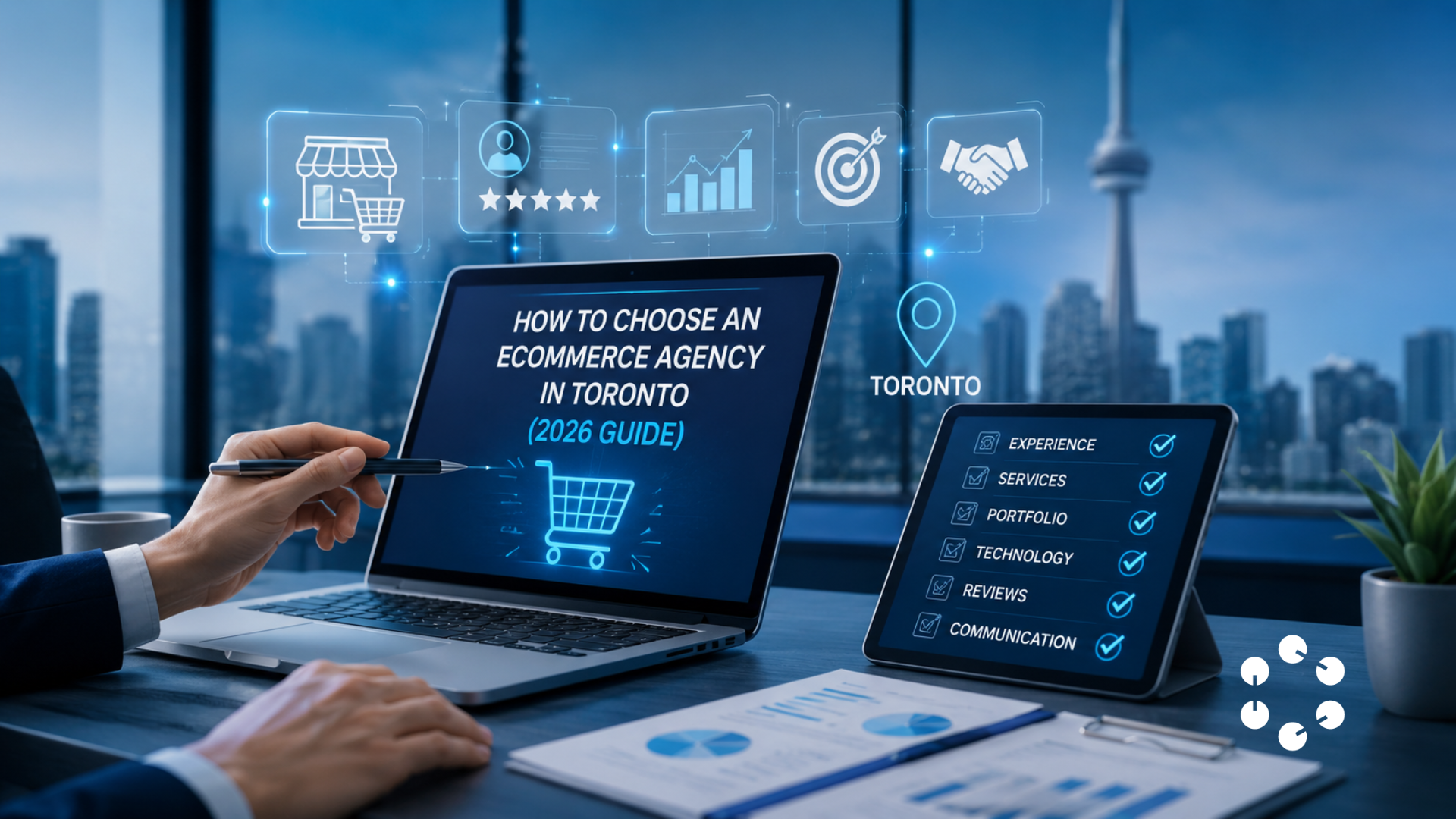
Choosing the wrong ecommerce agency can become an expensive mistake. A storefront may look polished on launch day, but poor mobile performance, weak SEO foundations, disconnected systems, slow load times and limited scalability can quietly undermine growth for years.
The ecommerce landscape in 2026 also looks very different from what it did just a few years ago. Businesses now compete in an environment shaped by AI-driven search, omnichannel customer journeys, mobile-first shopping behaviour, operational automation and rising customer expectations. Simply hiring a team to build a website is no longer enough.
Today, the best ecommerce agencies in Toronto help businesses improve far more than design. They support revenue growth, customer retention, conversion optimization, operational efficiency, AI discoverability and long-term scalability.
What Modern Ecommerce Businesses Need in 2026
Many agencies still approach ecommerce projects like traditional web design projects. The focus is placed heavily on visuals, while performance, operations, analytics and long-term growth receive far less attention.
Modern ecommerce businesses need far more than an attractive storefront.
Customers now expect fast mobile experiences, frictionless checkouts, personalized shopping journeys and seamless experiences across multiple channels. Simultaneously, businesses are managing increasingly complex operations involving inventory systems, CRMs, fulfillment tools, analytics platforms and marketing automation.
This is why choosing the right Toronto ecommerce development agency requires looking beyond aesthetics alone.
A modern commerce partner should understand:
- AI-assisted commerce
- conversion optimization
- fast storefront performance
- headless commerce architecture
- omnichannel integrations
- customer retention
- analytics and attribution
- operational automation
- scalable infrastructure
- mobile-first buying behaviour
The strongest ecommerce experts in Toronto are those helping businesses improve revenue, operations, customer experience, automation, retention and scalability.
AI ecommerce solutions are also rapidly transforming the industry. AI-assisted commerce now influences product recommendations, merchandising, customer support, predictive search, personalization and conversational shopping experiences.
And ecommerce automation has become essential for operational efficiency. Businesses increasingly rely on integrated systems that connect storefronts with fulfillment, customer support, inventory management, analytics and lifecycle marketing platforms.
This shift is why modern ecommerce trends in 2026 are heavily focused on performance, integration, automation and long-term customer value.
Businesses evaluating modern commerce infrastructure should also understand the growing role of headless commerce agencies, composable commerce solutions and scalable ecommerce CRO services in long-term digital growth.
Key Questions to Ask Before Hiring an Ecommerce Agency
Before hiring an ecommerce agency in Toronto, businesses should look beyond visual portfolios and ask deeper strategic questions.
Do They Specialize in Your Platform?
Not every agency has deep expertise across Shopify, Shopify Plus, Bigcommerce, headless commerce or composable architectures. Businesses should evaluate whether the agency has direct experience within the platform ecosystem they plan to scale on.
Can They Support Growth After Launch?
A website launch should not be the end of the engagement. Strong ecommerce consulting services should include CRO, analytics, experimentation, retention strategies, SEO growth and ongoing optimization support.
Do They Understand SEO and AI Search Visibility?
Modern ecommerce SEO now extends beyond traditional rankings. Businesses should ask whether the agency understands:
- structured data
- semantic search
- entity SEO
- AI-readable content
- conversational search optimization
- Google AI Overviews
- ChatGPT and Perplexity discoverability
AI search optimization is becoming a major competitive advantage in ecommerce.
How Do They Approach Ecommerce CRO?
Conversion rate optimization should be embedded into both design and development decisions. Businesses should ask how the agency handles:
- A/B testing
- heatmaps
- checkout optimization
- mobile UX improvements
- merchandising optimization
- customer journey analysis
Can They Handle Migrations Safely?
Ecommerce migration services require careful planning to preserve SEO equity, customer data, product structures, redirects and analytics continuity.
Poorly managed migrations can significantly impact rankings and revenue.
What Analytics and Reporting Do They Provide?
Strong ecommerce agencies should provide visibility into:
- conversion rates
- revenue attribution
- customer retention
- acquisition efficiency
- site performance
- funnel drop-offs
- merchandising performance
Can They Integrate Operational Systems?
Modern commerce requires integrations across ERPs, CRMs, POS systems, inventory tools, fulfillment software and marketing automation platforms.
Businesses should ensure their ecommerce development company understands operational complexity.
Have They Worked With Canadian Businesses Before?
Canadian ecommerce businesses face unique challenges involving taxes, shipping expectations, bilingual considerations, fulfillment logistics and regional customer behaviour.
Local experience can significantly improve execution quality.
Shopify vs Headless vs Custom Commerce
One of the biggest decisions many businesses face today is whether to use Shopify, headless commerce architecture or a fully custom commerce solution.
Shopify for Scaling Brands
For many growing brands, Shopify remains one of the strongest ecommerce platforms available. Shopify Plus, in particular, has become increasingly popular because it combines operational simplicity with scalability and ecosystem flexibility.
This is one reason Shopify Plus agencies in Toronto continue to see strong demand.
Businesses can launch faster, integrate tools more easily and avoid the heavy maintenance burden associated with fully custom commerce systems.
Headless Commerce for Flexibility and Performance
Headless commerce separates the frontend experience from the backend commerce engine, allowing businesses to create highly customized experiences across websites, mobile apps, kiosks, marketplaces and other digital touchpoints.
Technologies such as:
- Shopify Hydrogen
- Contentful
- APIs
- composable commerce stacks
are becoming increasingly common within headless commerce environments.
A headless commerce agency may be ideal for businesses prioritizing advanced performance optimization, custom customer experiences or omnichannel flexibility.
When Custom Commerce Builds Make Sense
Custom commerce platforms may still be valuable for businesses with highly specialized workflows, enterprise operational requirements or unique B2B commerce environments.
However, fully custom systems also introduce higher development costs, maintenance complexity and long-term infrastructure considerations.
The right decision depends on operational requirements, scalability goals, customer experience priorities and internal technical resources.
Red Flags to Watch Out For
Even in 2026, many businesses still choose ecommerce agencies based primarily on visual design alone.
While branding and aesthetics matter, they are only one part of a successful commerce experience.
Some major ecommerce agency red flags include:
- agencies focused only on design
- poor mobile optimization
- slow storefront performance
- no technical SEO capability
- cookie-cutter templates
- no post-launch optimization strategy
- weak analytics frameworks
- outdated platform recommendations
- no understanding of AI search optimization
- unrealistic pricing promises
Cheap ecommerce builds often create expensive technical debt later through poor architecture, weak SEO foundations, rushed integrations and scalability limitations.
Another growing concern is the lack of understanding among agencies of AI discoverability and semantic search optimization. Ecommerce websites increasingly require structured data, entity SEO, optimized product feeds and AI-readable architectures to remain competitive.
Businesses choosing ecommerce development partners should prioritize long-term scalability over short-term visual appeal alone.
Why Local Market Understanding Matters
Many businesses underestimate the importance of local market knowledge when choosing an ecommerce company in Toronto.
Canadian ecommerce environments involve unique operational and customer experience considerations, including:
- Canadian shipping and fulfillment expectations
- tax requirements
- bilingual content considerations
- seasonal retail behaviour
- North American delivery standards
- B2B and B2C hybrid commerce models
- local consumer purchasing behaviour
A Canadian ecommerce agency that understands these factors can make better strategic decisions around platform architecture, integrations, fulfillment workflows and customer experience optimization.
For businesses targeting both Canadian and U.S. markets, cross-border operational planning also becomes increasingly important.
Why Ongoing Growth & CRO Matter More Than Launch Day
One of the biggest misconceptions in ecommerce is that launching the website is the final milestone.
In reality, launch day is just the beginning.
The highest-performing ecommerce brands continuously optimize every part of the customer journey. Small improvements in conversion rates, checkout flows, mobile performance, merchandising, retention campaigns and search visibility can compound into significant long-term revenue growth.
Successful ecommerce optimization services often include:
- A/B testing
- heatmap analysis
- customer journey reviews
- lifecycle marketing
- Klaviyo email automation
- merchandising improvements
- campaign optimization
- search optimization
- performance tracking
- ongoing analytics monitoring
This is where ecommerce CRO agencies create long-term value.
Strong ecommerce retention strategies can significantly reduce acquisition costs while improving customer lifetime value and repeat purchase behaviour.
The best ecommerce growth agencies understand that performance optimization is not a one-time task. It requires continuous iteration, experimentation, reporting and operational alignment.
AI & Search Visibility in 2026
AI is rapidly changing how customers discover products online.
Google AI Overviews, conversational search, ChatGPT discovery, Perplexity recommendations, and semantic search systems are reshaping ecommerce visibility.
Traditional SEO alone is no longer enough.
Modern ecommerce websites increasingly require:
- AI-readable content structures
- entity SEO
- structured data
- semantic relevance
- optimized product feeds
- conversational content architecture
- clean technical performance
- scalable information architecture
AI-ready ecommerce websites are becoming a major competitive advantage.
Businesses investing in ecommerce AI SEO today are positioning themselves for future discoverability as AI-driven search continues evolving.
This shift is also influencing how ecommerce content is written, structured and organized. Ecommerce agencies increasingly need to think about how products, services and categories are interpreted not only by search engines but also by AI systems and conversational discovery platforms.
What a Strong Ecommerce Agency Partnership Looks Like
The best ecommerce agency relationships are built around long-term collaboration rather than short-term project delivery.
Strong ecommerce partner agencies typically provide:
- transparent communication
- strategic guidance
- technical and marketing alignment
- iterative optimization
- ongoing reporting
- operational consulting
- growth-focused decision making
Businesses should look for ecommerce consulting Toronto partners that understand both technology and growth strategy.
The strongest partnerships usually involve close collaboration across development, analytics, CRO, SEO, operations, automation and digital marketing teams.
This alignment becomes increasingly important as commerce ecosystems become more interconnected and operationally complex.
Businesses evaluating long-term ecommerce support should also consider whether the agency can support broader digital transformation goals involving systems integration, automation, AI enablement and omnichannel infrastructure.
What Does an Ecommerce Agency Do?
A modern ecommerce web development agency typically handles far more than website design.
Depending on the business needs, an ecommerce agency may provide:
- ecommerce strategy
- platform selection
- Shopify or headless development
- migrations and redesigns
- CRO and analytics
- SEO and AI search optimization
- systems integrations
- automation workflows
- retention marketing
- performance optimization
- ongoing technical support
The strongest ecommerce agencies combine technical execution with a long-term business growth strategy.
FAQs
How much does an ecommerce agency cost in Toronto?
Costs vary significantly depending on platform complexity, integrations, custom functionality, migration requirements and ongoing support needs.
A Shopify implementation may cost far less than a fully custom or headless commerce solution. Businesses should evaluate long-term operational value rather than focusing only on upfront pricing.
Should I hire a Shopify agency or a full-service ecommerce agency?
This depends on your growth stage and operational complexity.
A Shopify agency would be ideal for businesses focused primarily on Shopify ecosystem execution. A full-service ecommerce agency may be better suited for businesses requiring broader support involving CRO, integrations, AI optimization, analytics and omnichannel growth.
What is headless commerce?
Headless commerce separates the frontend customer experience from the backend commerce engine.
This allows businesses to create highly customized experiences across websites, apps, marketplaces, kiosks and other digital touchpoints whilst maintaining flexible backend operations.
How long does an ecommerce migration take?
Migration timelines vary depending on platform complexity, product catalogues, integrations, SEO requirements and custom functionality.
Some migrations may take a few weeks, while enterprise migrations would require several months of planning and implementation.
What KPIs should an ecommerce agency track?
Common ecommerce KPIs include:
- conversion rate
- average order value
- customer lifetime value
- cart abandonment
- retention rate
- revenue attribution
- page speed
- mobile performance
- organic visibility
- customer acquisition costs
Modern Commerce Growth
Choosing the right ecommerce agency in Toronto is about finding a partner that understands both commerce strategy and technical execution.
In 2026, businesses need far more than a visually appealing storefront. They need scalable infrastructure, strong mobile performance, conversion-focused experiences, AI-ready search visibility and long-term growth support.
The right agency partnership should help your business scale sustainably, even if you’re planning a Shopify migration, evaluating headless commerce, redesigning an existing storefront or improving ecommerce performance.
Businesses exploring modern ecommerce growth can also evaluate broader capabilities across AI enablement, digital systems integration, web engineering, customer experience development and digital marketing strategy.
Explore:
- Digital Marketing & Media Services
- Web, Mobile & Cloud Engineering
- Digital Transformation & Systems Integration
- AI Consulting & Enablement
- E-commerce Development Services
- Web & Digital Experience Development
- 6ixSenses Case Studies
- 6ixSenses Technology Stack
A strategy audit, platform evaluation, CRO review, migration consultation or AI commerce readiness assessment can help identify the strongest path forward for long-term ecommerce growth.


