AI for Ecommerce in Canada: What Works, What Doesn’t and What It Costs
AI in ecommerce has moved past the one day this will be important stage.
Canadian businesses already use AI to analyze data, generate content, automate customer service, personalize shopping experiences and streamline repetitive work.
Statistics Canada reported that 19.2% of Canadian businesses used AI to produce goods or deliver services in the 12 months leading up to Q2 2026, up from 12.2% a year earlier and 6.1% in Q2 2024. Among businesses already using AI, data analytics, text analytics and virtual agents or chatbots were among the most common applications.
But using AI and getting value from AI are two very different things.
You can add an AI chatbot to your ecommerce website in an afternoon. You can also spend months building an AI-powered commerce platform that nobody trusts, nobody uses and nobody can justify to the CFO.
And before investing in AI, make sure your ecommerce platform is right for your business. Compare Shopify Plus and BigCommerce to see which is better for Canadian retailers in 2026.
So what really works for Canadian retailers in 2026? Where should you spend money? What should you avoid? And how much does AI really cost?
AI works best when it is connected to a real business problem, reliable data and a measurable outcome.
It works much less well when a business starts with ‘we need AI' and figures out the problem afterward.
Where AI works in Ecommerce
We'd look at these areas first:
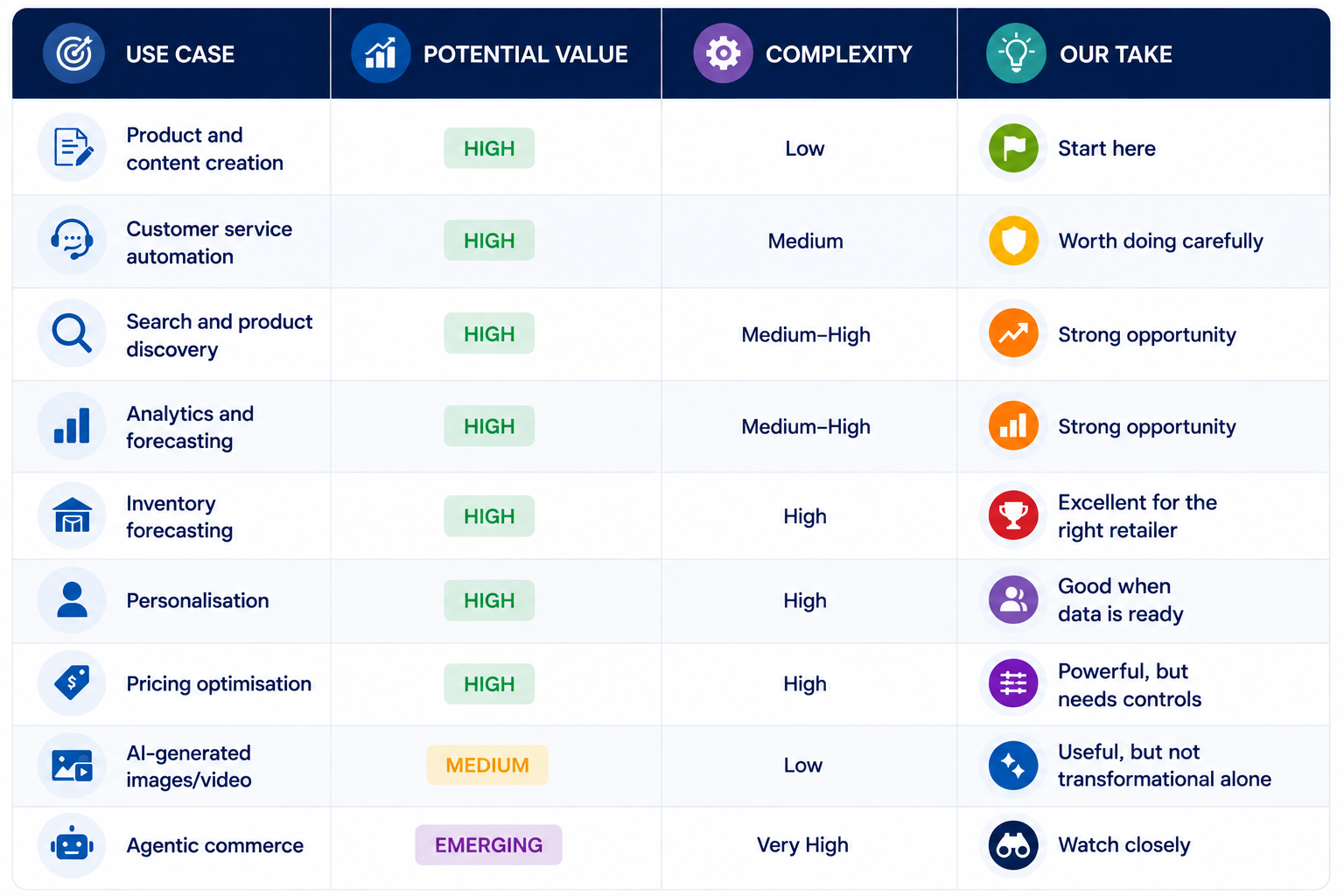
Notice what’s missing from the top of the list? A fully autonomous AI employee doing everything. The most valuable applications are not necessarily the flashiest ones. They’re the ones that save your team time, improve decisions, increase revenue or reduce operational friction.
1. AI for content and merchandising: the easiest win
If your ecommerce team has ever had to create thousands of product descriptions, meta descriptions, category pages or email variations, the appeal of AI is obvious.
AI can help with:
- Product descriptions
- Meta titles and descriptions
- Category copy
- FAQs
- Email drafts
- Ad variations
- Social content
- Product comparisons
- Content briefs
- Image backgrounds
- Content localisation
Shopify is a good example of this becoming part of the ecommerce platform itself. Shopify Magic provides AI features across areas such as text and media generation. Sidekick can help merchants analyze data, manage store tasks and create content. These capabilities are included with Shopify plans, although features and usage limits vary.
The important point is that retailers don't necessarily need to purchase a separate AI ecommerce platform to get started.
The catch: AI doesn’t know which product information is correct
Suppose your supplier spreadsheet says a jacket is 95% cotton and 5% elastane, your ERP says ‘cotton blend’, and your ecommerce catalogue says simply ‘cotton’.
AI can produce an excellent product description from that information.
It just might be wrong.
That’s why AI doesn’t replace good merchandising data. It makes good merchandising data more valuable.
Use AI heavily for first drafts, variations, organization and scale. Keep humans responsible for factual accuracy, brand voice, product claims and final approval.
This is one of the lowest-risk ways for most retailers to start using AI.
2. AI-powered customer service: valuable with guardrails
Customer service is another strong use case because ecommerce teams answer a lot of repetitive questions:
- Where is my order?
- What's your return policy?
- Do you ship to Alberta?
- What size should I buy?
- Is this product compatible with X?
- When will this item be back in stock?
AI is well suited to these questions when the underlying information is accurate and accessible.
The problem starts when a chatbot begins improvising.
If your return policy allows returns within 30 days and a customer asks about returning something after 45 days, your AI system shouldn't decide that 45 days ‘sounds reasonable’.
It needs to know the actual policy.
Good AI customer service therefore needs clear rules around:
- Which information the AI can access
- Which policies are authoritative
- What actions it can take
- When it must escalate
- What customer information it can access
- Which situations require human judgement
Human support should remain part of the workflow for complex complaints, high-value orders or sensitive situations.
Don’t replace your support team. You only have to stop your support team from spending its day answering questions a machine can safely handle.
And you can measure whether it is working through response time, ticket deflection, resolution rate, escalation rate and customer satisfaction.
3. Smarter search and product discovery
Traditional ecommerce search often relies heavily on keywords.
A customer might search: black waterproof winter jacket for hiking
while the catalogue contains: Men's Alpine Shell Jacket — Black
AI-powered search can understand the intent behind a query rather than simply matching individual words.
That can improve:
- Search relevance
- Product discovery
- Recommendations
- Merchandising
- Conversion
- Average order value
This becomes particularly valuable for retailers with thousands of SKUs, technical products, complex attributes or B2B catalogues.
BigCommerce is also investing in this area through its BigAI initiatives, including AI-powered product recommendations and AI-driven shopping experiences.
But, once again, search AI is only as good as the product data behind it.
If one product has ‘Waterproof: Yes’, another says ‘Water resistant,’ and another has no attribute at all, the system is working with inconsistent information.
That makes data standardization a commercial issue.
4. AI for analytics, forecasting and better decisions
This is where AI can become much more valuable than content generation.
Most ecommerce businesses already have huge amounts of data:
Orders. Customers. Products. Traffic. Returns. Inventory. Marketing spend. Margins. Discounts. Search behaviour.
The problem is rarely a lack of data. It’s knowing what to do with it.
Statistics Canada’s Q2 2026 data reflects this. Data analytics was the most commonly reported AI application among Canadian businesses already using AI, at 36.6%.
For an ecommerce business, AI can help answer questions such as:
- Which customers are most likely to purchase again?
- Which products are losing momentum?
- Which promotions are really profitable?
- Where are we overstocked?
- Which products are frequently purchased together?
- Which customers are likely to churn?
- Which marketing channels produce high-value customers?
- What demand patterns are emerging?
5. Inventory and demand forecasting
Forecasting can be one of the highest-value AI applications for retailers carrying physical inventory.
Too much inventory ties up cash. Too little inventory means missed sales. And demand can change based on seasonality, promotions, geography, customer behaviour and external factors.
AI can analyze historical sales and other signals to identify patterns and improve demand forecasting.
But forecasting has a fundamental requirement: the underlying data needs to be trustworthy.
If inventory counts are inaccurate, historical sales are incomplete or promotions aren't properly recorded, the model is learning from bad information.
AI doesn't make that problem disappear. It makes it more visible.
6. Personalization: powerful, but don’t rush into it
‘Every customer gets a personalized shopping experience’ sounds great in a strategy presentation.
But delivering it is more harder. Effective personalization can require:
- Customer data
- Behavioural signals
- Segmentation
- A CRM or CDP
- Product data
- Real-time integrations
- Enough traffic to measure the impact
A sophisticated personalization engine may not be the best first investment for a small retailer with limited customer data.
And for a large retailer with millions of sessions, extensive product data and a mature CRM/CDP environment, it can be a very different story.
Personalization can influence product recommendations, search results, merchandising, email campaigns, promotions and retention. But don’t personalize simply because you can. Personalize where it changes customer behaviour.
What doesn’t work: adding AI without a business case
One of the easiest mistakes is this mindset: our competitors have AI; we need AI too.
Because then comes the chatbot. Then the integration. Then the monthly subscription. And eventually it’ll go to ‘AI isn't really working for us.’
The problem might not be the technology. It can be the absence of a measurable objective.
Compare these two approaches:
Weak:
We want an AI chatbot.
Strong:
Our support team spends 30% of its time answering repetitive order-status questions. And we want to reduce that workload by 25%.
The second gives you something you can measure.
The same principle applies elsewhere:
- Reduce product-content production time by 50%.
- Improve product-search conversion by 10%.
- Reduce manual order-processing time by 30%.
- Improve demand forecasting accuracy.
AI should be attached to a business outcome and not added because it sounds innovative.
What doesn’t work: AI without clean data
This is arguably the biggest issue in ecommerce AI. AI cannot fix data chaos.
AI can generate inconsistent content faster if your product information is inconsistent. If your inventory data is wrong, AI can make inaccurate recommendations faster. AI can create confused customer segments faster if customer records are duplicated across systems,
If your ERP, CRM and ecommerce platform disagree about pricing or inventory, an AI system has no way of knowing which source is correct.
This is why AI readiness starts with the fundamentals:
Clean data + connected systems + clear processes + defined business rules.
Being AI-ready is not about having the newest model. It means your business has information that AI can understand and use reliably.
What about autonomous and agentic commerce?
This is one area worth watching closely.
AI is moving beyond answering questions and generating content towards systems that can search, compare products and potentially take actions on behalf of customers.
BigCommerce has positioned agentic commerce as an emerging part of the next phase of ecommerce. Shopify is also developing ways for merchants to sell through AI-driven shopping channels.
That could eventually change how customers discover and purchase products.
But there is an important difference between:
Let AI recommend this product.
and:
Let AI decide what this customer buys, what price they pay and which promotion applies.
The second requires considerably stronger controls.
So, for most retailers, we’d recommend progressing through:
- Assist (2) Recommend (3) Automate (4) Act
How much does AI for Ecommerce cost in Canada?
The cost depends on whether you’re buying a tool, integrating several systems or redesigning part of your commerce infrastructure.
Level 1: Basic AI tools
Typical cost: $0-$500+ CAD/month
This includes tools for writing, research, image generation, productivity, basic analysis and content creation. Some ecommerce platforms already include AI features. Shopify Magic and Sidekick, for example, are included within Shopify plans subject to feature availability and usage limits. This is the lowest-risk place to start. You don’t need a six-month AI transformation project to save your content team hours every week.
Level 2: Specialist AI ecommerce software
Typical cost: hundreds to several thousand dollars per month
This can include:
- AI customer service
- Advanced search
- Recommendations
- Personalisation
- Pricing intelligence
- Merchandising
- Forecasting
- Marketing automation
Costs vary considerably based on traffic, order volume, data volume and functionality.
The danger here is subscription sprawl. Five small AI tools can become a large annual technology bill.
Level 3: AI integration and automation
Planning range: roughly $5,000-$25,000+ CAD for a focused implementation
This is where AI starts interacting with your existing systems.
For example:
(1)Shopify (2)AI service (3)ERP
or:
(1)CRM (2)customer data (3)AI segmentation (4)marketing automation
or:
(1)Product database (2)AI enrichment (3)ecommerce catalogue
Actual costs depend on API complexity, data quality, systems involved and the degree of automation required. This is not a standard market price. It’s a planning range. Enterprise integrations can cost substantially more.
Level 4: Larger AI transformation
Planning range: $25,000-$100,000+ CAD
At this level, you’re potentially dealing with:
- Data architecture
- ERP/CRM/ecommerce integration
- Custom AI applications
- Customer data platforms
- Forecasting
- Recommendation engines
- Automated workflows
- Governance
- Security
- Monitoring
- Ongoing optimisation
The question has changed from:
Which AI tool should we buy?
to:
What should our AI-enabled commerce architecture look like?
That’s a much bigger project. And remember: the software subscription is only part of the cost.
You’d also need to budget for data cleanup, integration, development, testing, training, governance and ongoing optimization.
Privacy and data governance
Canadian retailers also need to consider how AI interacts with customer information.
AI systems may process names, purchase history, customer messages, behavioural data and other personal information. Businesses remain responsible for how personal information is collected, used, disclosed and protected under applicable Canadian privacy laws.
The Office of the Privacy Commissioner of Canada notes that organizations subject to PIPEDA have obligations relating to areas including meaningful consent, safeguards and breach management.
Before connecting customer data to an AI system, ask:
- What information is being sent?
- Where is it processed?
- How long is it retained?
- Who can access it?
- Is it used to train models?
- Can it be deleted?
- What permissions does the AI system have?
- What happens when the AI makes a mistake?
It's handled by the AI vendor is not a complete privacy strategy.
Where should a Canadian retailer start?
You don’t need to transform your entire business overnight. In fact, we'd recommend the opposite.
1. Find the expensive repetitive work
Look for processes that are:
- High-volume
- Repetitive
- Time-consuming
- Rules-based
- Currently handled manually
These are your easiest AI opportunities.
2. Identify decisions that could be better informed
Look at forecasting, customer segmentation, merchandising, recommendations, pricing and marketing allocation.
These may become your higher-value AI opportunities.
3. Audit your data
Ask these questions:
- Is our product data accurate?
- Is inventory reliable?
- Are customer records unified?
- Do our systems agree on pricing?
- Do we have a clear source of truth?
If the answer is no, address the foundation before adding sophisticated AI.
4. Choose one measurable use case
Don't launch an AI transformation. Launch a specific project with a specific outcome.
For example:
Reduce support workload by 25%.
or:
Cut product-content production time by 50%.
or:
Improve onsite search conversion by 10%.
5. Prove it before scaling it
If it works, expand it. If it doesn't, find out why.
Maybe the technology wasn't good enough. Perhaps the data wasn't ready. Maybe the workflow was poorly designed. Maybe the problem wasn't valuable enough to solve. All of these are useful answers.
The real advantage is not having more AI
The retailers that get the most from AI won't necessarily be the ones buying the most AI tools.
They’ll be the ones with: Clean data + connected systems + clear processes + measurable goals + appropriate AI.
That’s why AI strategy increasingly overlaps with ecommerce architecture, ERP integration, CRM, customer data and digital infrastructure.
If your Shopify or BigCommerce store doesn't know what's happening in your ERP, AI can't magically solve that. AI won't suddenly create a perfect customer profile if customer information lives across four disconnected systems. AI will struggle to deliver reliable recommendations if your product catalogue is inconsistent. And if an internal process is broken, automating it simply helps you break it faster.
AI doesn’t replace good infrastructure. It makes good infrastructure more valuable.
Make AI work for your ecommerce business
The biggest AI mistake is not choosing the wrong model. It’s choosing a solution before understanding the problem.
At 6ixSenses, we approach AI as part of the wider ecommerce and digital systems architecture. That can mean identifying high-value AI opportunities, auditing your technology stack, standardizing ecommerce data, connecting ERP and CRM systems, automating workflows, improving customer data, implementing AI-powered search and recommendations, or designing custom integrations.
Our ecommerce services cover strategy, Shopify and BigCommerce development, ERP/POS/CRM integrations, automation, analytics, B2B commerce and ongoing ecommerce operations.
For businesses where the challenge starts deeper than the storefront, our digital systems & infrastructure services cover technology assessment, ERP strategy, process automation, system integration, analytics and digital transformation.
And if you’re still figuring out where AI fits, our AI enablement services focus on applying AI to smarter business operations, profitability and automation.
Because the aim is not to have the most AI. It’s to have a better business because of it.


